
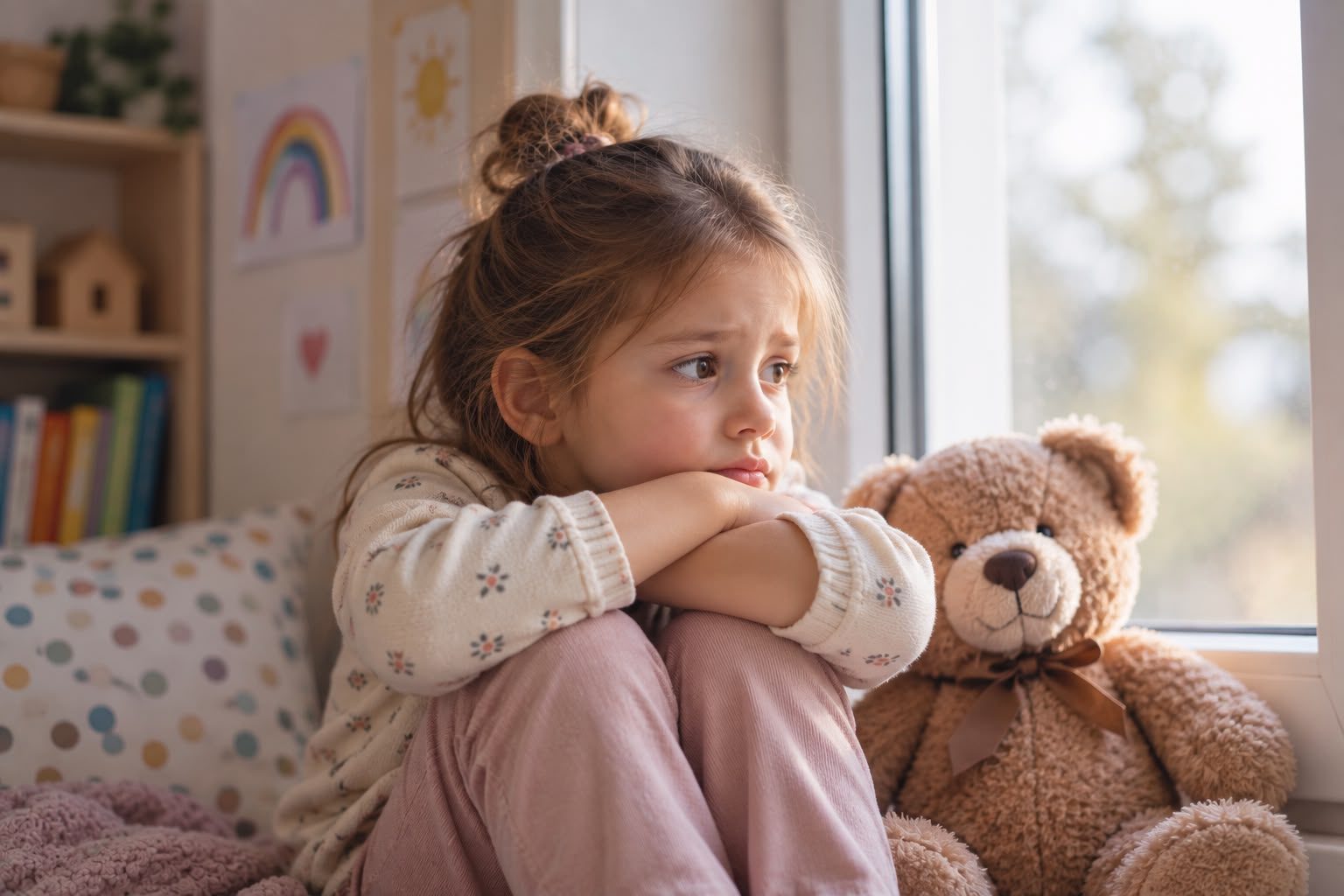
What is Separation Anxiety in Children?
It may be natural at some stages of development for the child to experience a certain level of anxiety when separating from the mother, father, or caregiver who is important to him/her.
However, separation anxiety may need to be evaluated in detail when the fear of separation is more intense than expected according to the child's age and developmental period, persists for a long time, and significantly affects school, sleep, social life, or family order.
With What Symptoms Can Separation Anxiety Be Seen?
Symptoms may vary according to the age and developmental characteristics of the child. Common conditions may include:
- Intense crying when leaving mother or father
- Constantly following the parent
- Not wanting to be alone in a different room at home
- Not wanting to go to school or kindergarten
- Hold on tightly to the parent while being dropped off at school
- Fear that something bad will happen to the parent
- Intense worry about being lost or kidnapped
- Inability to sleep alone
- Wanting to sleep next to a parent
- Going to the parent at night
- Not wanting to stay outside the home or elsewhere
- Experiencing abdominal pain or nausea before separation
- Constantly wanting to reach the parent by phone
At What Ages Can Separation Anxiety Be Normal?
Reacting to separation from the caregiver in infancy and early childhood can be a natural part of development. As the child's development progresses, the capacity to safely leave and understand that the caregiver will return increases.
For this reason, it is not concluded that there is a psychological disorder only with the knowledge of "The child does not want to leave his mother". The child's age, level of development, intensity of anxiety, duration and effect on functionality are evaluated together.
Why Can Separation Anxiety Occur?
There is no single cause for separation anxiety. The child's temperament, predisposition to anxiety, interactions within the family and environmental events may play a role together.
Starting school, moving, illness, hospitalization, changes in the family, loss, prolonged separation from the parent or experiences that affect the child's perception of safety may be accompanied by increased anxiety about separation in some children.
Why is there a fear that something will happen to the mother or father?
Some children who experience separation anxiety may think that something bad will happen to them when they are away from their parents.
The child may often ask questions such as “You're not going to die, are you?”, “You're not going to have an accident, are you?” or “You're going to come get me, aren't you?”
Providing firm reassurance to these questions over and over again can relieve the child for a short time. But when reassurance-seeking behavior becomes continuous, it can contribute to the continuation of the cycle of anxiety.
Can Separation Anxiety Cause Abdominal Pain and Nausea?
Anxiety can occur in children with bodily symptoms. Abdominal pain, nausea, headache or similar complaints may occur, especially when it is close to the time to go to school or leave the parent.
It should not be assumed that physical complaints are not real. The child can really feel the physical effects of anxiety. However, it is important to properly evaluate possible medical causes for recurrent or significant physical symptoms.
Are Separation Anxiety and School Refusal the Same Thing?
No. Separation anxiety may be one of the reasons some children don't want to go to school, but there are many different reasons for school refusal.
Peer bullying, academic difficulties, teacher or friend relationships, social anxiety, performance anxiety, and negative experiences at school can also cause the child to not want to go to school.
For this reason, it should not be thought that every child who does not want to go to school has separation anxiety.
How to Approach a Crying Child While Dropping off at School?
It is important not to underestimate the child's feeling. However, continuing to say goodbye for too long or constantly postponing the separation may contribute to the continuation of anxiety in some children.
It can be helpful to establish an age-appropriate, predictable, and short farewell routine. The use of concrete expressions that the child can understand when the parent will return can also support the sense of trust.
Should the child be brought home from school when crying?
This decision should be evaluated according to the age of the child, the cause of the anxiety he/she experiences and the conditions in the school environment.
Walking away from school every time due to anxiety can cause the child to relax for a short time. However, the child may develop a learning in the form of "When I get anxious, I should get away from there" over time.
Therefore, when school-avoidance behavior intensifies, it may be beneficial for the family, school, and mental health professional to plan together when necessary.
Could the Child's Sleeping with the Mother or Father Be Related to Separation Anxiety?
In some children, not being able to sleep alone may be part of separation anxiety. The child may not want to be separated from the parent during sleep or may be afraid that something bad will happen to the parent at night.
But not every co-sleeping behavior is a psychological problem. The order of the family, cultural characteristics, the age of the child and the reasons for the behavior should be evaluated together.
What is the Avoidance Cycle in Separation Anxiety?
When the child avoids separation, his/her anxiety decreases for a short time. For example, he/she may relax when he/she does not go to school or when his/her parent stays with him/her
This relaxation can reinforce avoidance behavior. Since the child does not experience separation, he/she may have difficulty in gaining the experience of "I can do this".
Understanding this cycle in the process of psychological support is one of the important areas of study.
How is Separation Anxiety Evaluated?
The assessment examines when anxiety begins, in which separation situations it occurs, how long it lasts, and how it affects the child's daily life.
The child's developmental history, changes in family life, school process, sleep patterns, and other symptoms of anxiety are also included in the assessment.
Clinical interview with the child, play and observation, parental interviews, teacher information and age-appropriate psychological scales can be used when necessary.
How to Study Separation Anxiety Therapy
Psychological support is planned according to the age of the child and the characteristics of the anxiety. While play-based studies and parental counseling may be more prominent in younger children, cognitive and behavioral methods can be utilized in older children.
Areas where you can work include:
- Recognizing and making sense of anxiety
- Noticing signs of physical anxiety
- Anxiety coping skills
- Reducing assurance-seeking behavior
- Gradual adaptation to separation
- Developing independence skills
- Reducing avoidance behaviors
- Emotion regulation.
- Editing parental attitudes
Should the child be forced to leave?
The aim is not to force the child into an unprepared separation where he/she experiences intense anxiety. Likewise, continuous protection of the child from all separation situations may make it difficult for him/her to become independent.
The development of the child's ability to cope with separation can be supported by planning safe and gradual experiences suitable for his/her age and needs.
Why is Parental Counseling Important?
Parents' reactions to separation anxiety can play an important role in managing the child's anxiety.
Ebeveyn danışmanlığında vedalaşma biçimi, güvence verme davranışı, sınırlar, çocuğun bağımsızlığının desteklenmesi ve kaygı anlarında ebeveynin nasıl yaklaşabileceği üzerinde çalışılabilir.
Ne Zaman Profesyonel Destek Alınmalı?
Ayrılma kaygısı çocuğun okula devamını, uyku düzenini, sosyal ilişkilerini veya aile yaşamını belirgin biçimde etkiliyorsa psikolojik değerlendirme düşünülebilir.
Özellikle çocuk uzun süre okula gidemiyor, ebeveynden neredeyse hiç ayrılamıyor veya kaygı giderek daha fazla alana yayılıyorsa erken değerlendirme sorunun kronikleşmesini önlemek açısından yararlı olabilir.