
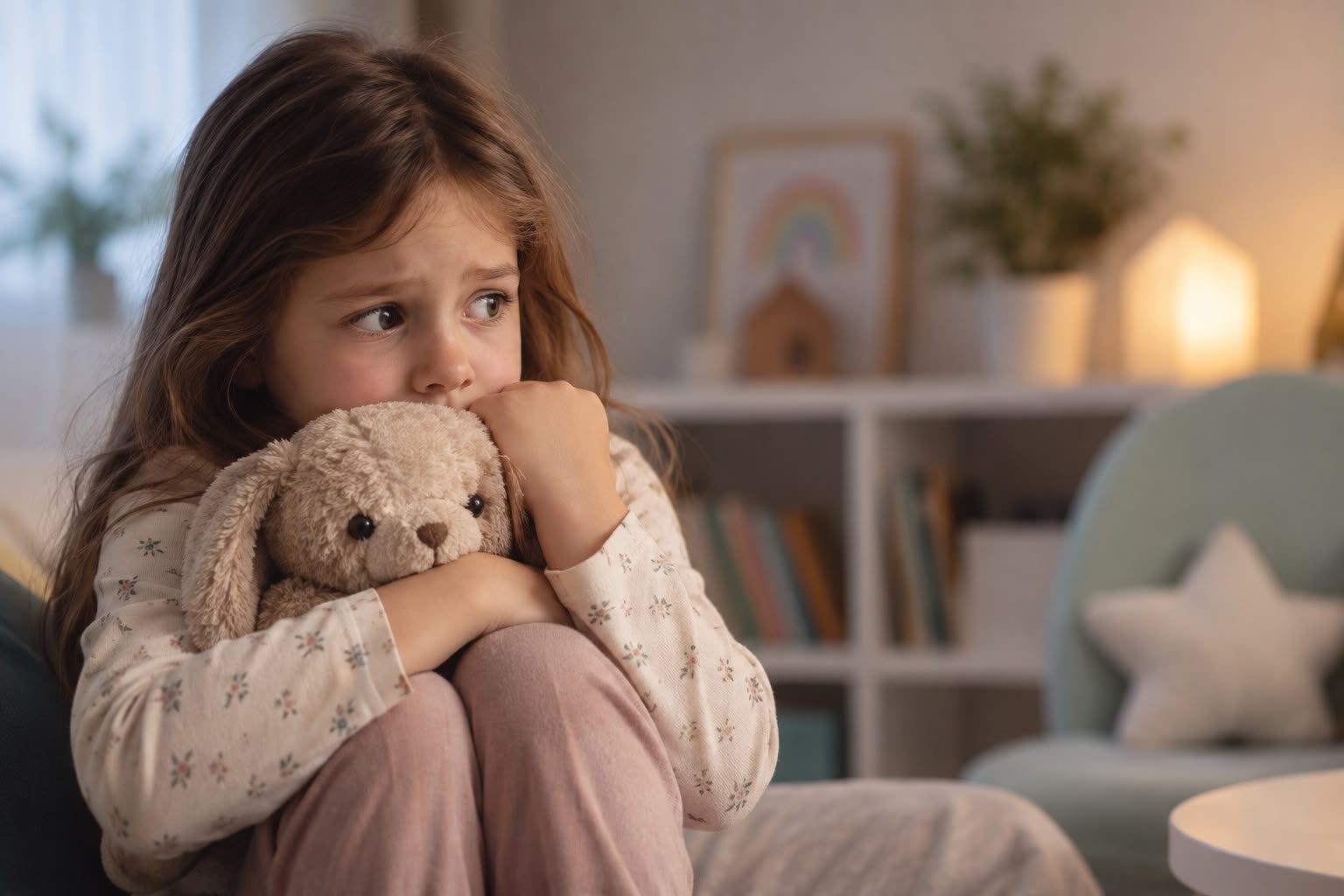
What is Anxiety in Children?
Anxiety is a natural emotion that children may experience at certain levels during the developmental process. Starting a new school, leaving the parent, taking an exam, or encountering an unprecedented situation can cause anxiety in the child.
However, professional evaluation may be required when anxiety is more intense than expected according to the child's age and developmental period, persists for a long time, or significantly affects school, family, and social life.
How to Understand Anxiety in Children?
Children may not always express their anxiety as “I am anxious” or “I am anxious”. Especially in young children, anxiety may occur with behavioral or physical symptoms.
Some of the symptoms that can be seen are:
- Constantly looking anxious
- Difficulty in separating from parents
- Not wanting to be alone
- Not wanting to go to school
- Constantly thinking something bad is going to happen
- Fear that something will happen to mom or dad
- Avoiding new environments
- Intense shyness in social settings
- Seeking continuous reassurance
- Difficulty falling asleep
- Nightmares or night terrors
- Stomache ache-abdominal pain
- Headache
- Nausea
- Intense crying or anger reactions
Why Is Anxiety Sometimes Seen as Abdominal Pain in Children?
Anxiety is not limited to thoughts. The body's stress system also accompanies anxiety. For this reason, some children may have bodily symptoms such as abdominal pain, nausea, headache, sweating, tremor or accelerated heart rate.
In recurrent or unexplained physical complaints, it is important to properly evaluate possible medical causes as well as psychological factors.
Why Does Anxiety Occur in Children?
Childhood anxiety usually has no single cause. Biological predisposition, temperament characteristics, learned behaviors, life events, family and environmental factors can be effective together.
Situations that may be associated with anxiety may include changes in the family, school problems, peer relationships, challenging life events, loss, illness experiences, and intense performance expectations.
What Anxiety Problems Can Be Seen in Children?
Anxiety in childhood can come in different forms:
- Separation Anxiety
- Widespread and excessive anxiety
- Social Anxiety
- Specific fears and phobias
- School-related anxiety and avoidance
- Panic-like symptoms
- Intense fears of certain situations
Correct determination of the type of anxiety is important in terms of planning the psychological support to be applied.
What is the Difference Between Normal Childhood Fear and Anxiety Disorder?
Some fears may be expected to emerge during children's developmental periods. Young children may have fears about separation from the parent, darkness, or imaginary entities.
In the clinical significance of a fear, not only its presence but also its intensity, how long it lasts, its suitability for the age of the child and the extent to which it affects his/her daily life are taken into account.
Why Does the Anxious Child Seek Continuous Reassurance?
Anxious children may repeatedly ask questions such as “Mom, you're going to be okay, right?”, “Will I definitely make it?”, or “Nothing bad is going to happen, right?”
Providing reassurance from the parent can provide short-term relief. However, when the child cannot learn to cope with uncertainty, the need to ask for reassurance may arise.
Therefore, the aim is not to eliminate every anxiety of the child, but to improve the ability to cope with uncertainty and anxiety.
Why Avoidance Can Increase Anxiety
When the child moves away from the situation he/she is afraid of, his/her anxiety may decrease for a short time. This relief may make the child think that avoidance works.
However, in the long run, the child cannot experience that he/she can cope with the situation he/she is afraid of. Thus, avoidance behavior can contribute to the continuation of anxiety.
Is It Right to Force the Child to Do What He/She Is Afraid of?
In order to reduce anxiety, it may not be appropriate to force the child into a situation where he/she experiences intense fear unpreparedly.
While working with anxiety, planned and gradual methods suitable for the age and characteristics of the child can be used. The aim is not to scare the child, but to support him/her to experience that he/she can cope with the situations he/she is afraid of.
Can Anxiety Affect the Child's School Life?
Yes. Because of anxiety, the child may avoid speaking in class, giving presentations, taking exams, communicating with friends, or going to school.
Although academic performance is good in some children, intense anxiety may be found. Therefore, just because school grades are good does not mean that there is no psychological difficulty.
Can Anxiety Cause Sleep Problems?
Anxious children may have difficulty stopping their thoughts as they go to sleep, may not want to be separated from their parents, or may be afraid that something bad will happen at night.
Since sleep problems and anxiety can affect each other, it may be useful to address sleep patterns in the evaluation.
How to Evaluate Anxiety in Children?
The evaluation addresses the child's age, developmental characteristics, when anxiety begins, in which situations it increases, and its effects on daily life.
Parental interview, clinical interview with child and observation provide basic information. Age-appropriate anxiety scales and teacher information can also be used when necessary.
Psychological scales alone do not diagnose; they are tools that support clinical evaluation.
How to Work in Anxiety Therapy in Children?
Psychological support is planned according to the age, developmental level and characteristics of the anxiety experienced by the child. In particular, cognitive behavioral therapy-based methods can be used.
Depending on the needs of the child, studies can be carried out in the following areas:
- Recognizing anxiety and bodily symptoms
- Recognizing thoughts that trigger anxiety
- Developing more balanced thinking skills
- Emotion regulation.
- Breathing and relaxation skills
- Problem Solving
- Coping with uncertainty
- Reducing assurance-seeking behavior
- Evaluating avoidance behaviors
- Ability to work gradually with feared situations
Why is the role of parents important?
Parents' approach to childhood anxiety can be an important part of the therapy process. Trying to protect the child from all his/her fears as well as underestimating his/her anxiety can make it difficult to manage the anxiety.
In parent counseling, it can be worked on not unintentionally reinforcing avoidance and supporting age-appropriate independence while acknowledging the child's emotion.
What Can Be Told to the Anxious Child?
Instead of saying “There is nothing to be afraid of” or “What is there to be afraid of?”, expressions that recognize the feeling the child is experiencing can be used.
For example, “I see that this worries you. It sounds difficult, but we can think together about how we can cope with it." An approach such as this can help to accept the child's emotion.
Should Anxiety Be Completely Eliminated?
The goal of the therapy process is not to remove all anxiety from the child's life. Anxiety is one of the natural emotions of man and in some cases has a protective function.
The aim is for the child to be able to recognize and manage his/her anxiety and to participate in important activities in his/her daily life despite experiencing anxiety.
When to seek help
Psychological evaluation may be considered if the anxiety persists for a long time, affects the child's school, sleep, family or friendship life, or the child begins to avoid more and more things due to situations he/she is afraid of.
More comprehensive assessment should not be delayed if the intense anxiety is accompanied by significant loss of function, severe sleep or nutritional problems, inability to attend school, or thoughts of self-harm.